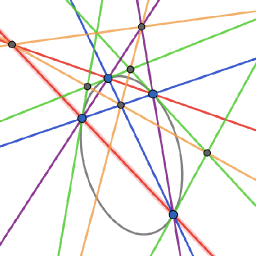
At our Projective Geometry Club meeting this afternoon (July 2, 2026), the question came up when two triangles can be polar partners with respect to a conic. We recalled that we had met this question before and that the answer is: “If and only if the two triangles are in perspective, that is, exactly when they give rise to a Desargues configuration.”
I asked Google’s Gemini AI: “Given a Desargues configuration, is it always possible to find a conic whose polarity maps the Desargues configuration to itself?
The rest of this post summarizes its answer. First it explained two classical theorem, Chasles’ Polar Triangle Theorem and its converse, Hesse’s Perspective Triangle Theorem.
Chasles’ Triangle Theorem: if two triangles are polar with respect to a conic, then they are in perspective.
Hesse’s Perspective Triangle Theorem: given any Desargues configuration in the plane, there is a unique conic such that the configuration is self-polar wrt the conic.
Hesse’s Triangle Theorem #
For any Desargues configuration (10 points, 10 lines) in the real or complex projective plane, there is a non-degenerate conic with respect to which the configuration is perfectly self-polar. This means the pole of every line in the configuration is a point in the configuration, and the polar of every point is a line in the configuration.
Here is the geometric and algebraic proof of how this conic is constructed.
1. The 3D Origin of the Configuration #
To find the conic, it is best to view the 2D Desargues configuration as a projection of a 3D structure.
Take a complete 5-point in $\mathbb{P}^3$ (five points $v_1, \dots, v_5$ in general position).
- These 5 points determine $\binom{5}{2} = 10$ lines in $\mathbb{P}^3$.
- They also determine $\binom{5}{3} = 10$ planes in $\mathbb{P}^3$.
If you slice this 3D arrangement with a general 2D plane $\Pi$, the 10 lines pierce $\Pi$ to create 10 points, and the 10 planes intersect $\Pi$ to create 10 lines. Because the 3 lines $v_av_b$, $v_bv_c$, and $v_av_c$ lie in the single plane $v_av_bv_c$, their 3 intersection points in $\Pi$ will lie on a single line.
This planar section is exactly the Desargues configuration.
2. The Algebraic Setup #
Let’s build coordinates for this. The plane $\Pi$ can be seen as the kernel of a linear functional $\phi$. By scaling the vectors $v_1, \dots, v_5$, we can choose them such that $\phi(v_i) = 1$ for all $i=1, \dots, 5$.
The 10 points in the plane $\Pi$ are generated by the vectors:
$$P_{ab} = v_a - v_b \quad (\text{for } 1 \le a < b \le 5)$$Notice that $\phi(P_{ab}) = 1 - 1 = 0$, so these points indeed lie in the plane $\Pi$.
The 10 lines in $\Pi$ correspond to the triples $\{c, d, e\}$. The line $L_{cde}$ is the line containing the three points $P_{cd}, P_{de},$ and $P_{ce}$.
3. The Abstract Polarity #
A polarity must map points to lines bijectively while preserving incidence. In the Desargues configuration, there is a very natural abstract matching: Map the point $P_{ab}$ to the line $L_{cde}$, where $\{c, d, e\}$ are the remaining three indices from the set $\{1, 2, 3, 4, 5\}$.
For example, the point $P_{12}$ is matched to the line $L_{345}$.
4. Finding the Conic #
To find the conic that geometrically realizes this abstract polarity, we need a symmetric bilinear form $B(x, y)$ on the plane $\Pi$ such that $B(P_{ab}, P_{cd}) = 0$ whenever $\{a, b\}$ and $\{c, d\}$ are completely disjoint sets. If this holds, $P_{cd}$ lies on the polar line of $P_{ab}$.
Because the 5 points $v_i$ live in a 4-dimensional vector space (since they are in $\mathbb{P}^3$), there is exactly one linear dependency between them (up to scale):
$$\sum_{i=1}^5 c_i v_i = 0$$Because $\phi(v_i) = 1$ and $\phi(0) = 0$, applying $\phi$ to this dependency gives us:
$$\sum_{i=1}^5 c_i = 0$$Now, define a quadratic form on the coordinates $x = (x_1, \dots, x_5)$ as follows:
$$Q(x) = \sum_{i=1}^5 \frac{x_i^2}{c_i}$$Because the coordinates $x_i$ have a dependency, we must check if this quadratic form is well-defined on the plane $\Pi$. If we shift $x_i \to x_i + t c_i$ (which represents the exact same vector in our space), the value becomes:
$$Q(x + t c) = \sum_{i=1}^5 \frac{(x_i + t c_i)^2}{c_i} = \sum_{i=1}^5 \frac{x_i^2}{c_i} + 2t \sum_{i=1}^5 x_i + t^2 \sum_{i=1}^5 c_i$$- We know $\sum c_i = 0$.
- Because $x$ represents a point in $\Pi$ (meaning $x$ is a linear combination of vectors like $v_a - v_b$), the sum of its coordinates $\sum x_i$ is also $0$.
Therefore, $Q(x + t c) = Q(x)$. The quadratic form is perfectly well-defined!
5. Verifying the Polarity #
Let’s look at the associated bilinear form: $B(x, y) = \sum_{i=1}^5 \frac{x_i y_i}{c_i}$.
Take a point $P_{ab}$ (where $x_a = 1, x_b = -1$, and the rest are $0$) and a point $P_{cd}$ (where $y_c = 1, y_d = -1$, and the rest are $0$). Because the sets $\{a, b\}$ and $\{c, d\}$ are disjoint, they share no non-zero coordinates.
$$B(P_{ab}, P_{cd}) = \sum_{i=1}^5 \frac{x_i y_i}{c_i} = 0$$This guarantees that $P_{cd}$, $P_{de}$, and $P_{ce}$ all lie on the polar line of $P_{ab}$. Since those three points span the line $L_{cde}$, the polar of the point $P_{ab}$ is exactly the line $L_{cde}$.
Because the 5 original points $v_i$ were in general position, no $c_i = 0$, meaning the form is non-degenerate. Because $\sum c_i = 0$, the $c_i$ values must have mixed signs, meaning the quadratic form is indefinite. In the real projective plane, an indefinite non-degenerate quadratic form always defines a real, valid conic.
Fun Fact #
While we just constructed one conic using the natural complement map $\{a,b\} \leftrightarrow \{c,d,e\}$, the automorphism group of the Desargues configuration (which is isomorphic to the symmetric group $S_5$) contains other involutions that also satisfy the conditions for a polarity.
Because of this, it is a classical theorem in projective geometry that a general Desargues configuration is self-polar with respect to exactly six different conics!